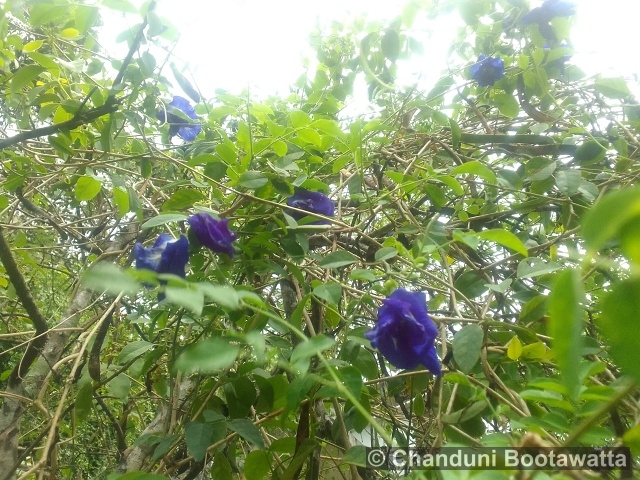
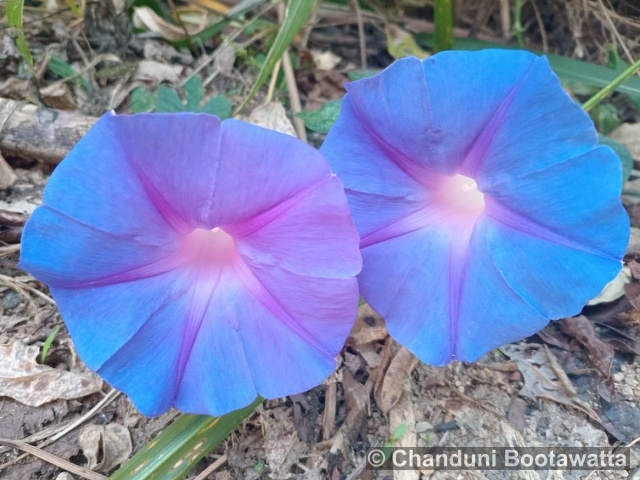
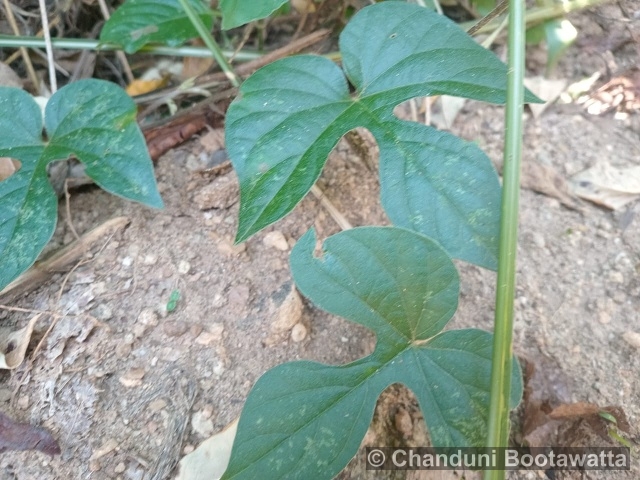
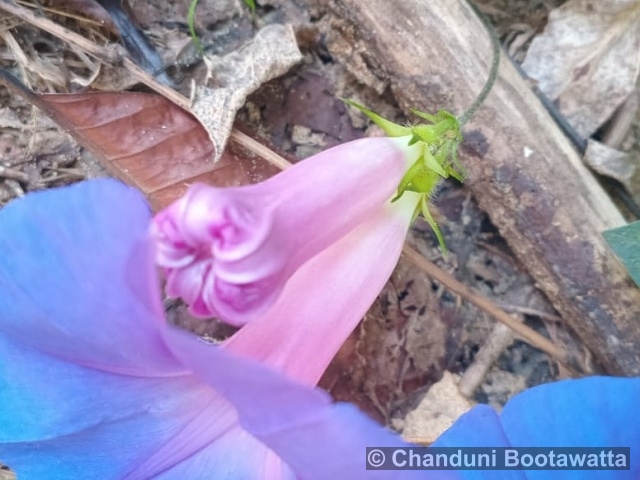
Description: It has long, trailing stems that twine over supports and other vegetation. The leaves are simple, broad, heart-shaped to three-lobed, and dark green in color with a soft texture. The flowers are large, funnel-shaped, and typically bright blue to violet with a pale or white center, blooming mainly in the morning and closing later in the day. The fruit is a small capsule containing several black seeds.
Substitutes – Ipomoea purpurea – Common morning glory with purple, pink, or white funnel-shaped flowers. – Ipomoea tricolor – Known for bright blue flowers with a white/yellow throat, very ornamental. – Ipomoea cairica – A fast-growing climber with pale purple to pink flowers, similar spreading habit. – Thunbergia grandiflora – Blue trumpet vine with large showy flowers, commonly used for fences and walls.
Ecology: Ipomoea indica grows well in tropical and subtropical climates, commonly found in disturbed areas, forest edges, roadsides, and gardens. It prefers well-drained sandy or loamy soils that are moderately fertile but can also tolerate poor soils. The plant thrives in full sunlight to partial shade, with optimal growth in warm temperatures around 20°C to 35°C. It requires moderate moisture, growing best in consistently moist soil but it is also somewhat drought-tolerant once established. However, it does not tolerate waterlogged conditions.
Distribution: Ipomoea indica is believed to be native to tropical regions of the Americas, but it is now widely distributed throughout the world. It is commonly found in South and Southeast Asia, Africa, Australia, the Pacific Islands, and many tropical and subtropical regions globally. The plant is also present in Sri Lanka, where it grows abundantly in gardens, roadsides, fences, and disturbed lands.
Use: The plant is mainly used as an ornamental climber for covering fences, walls, and trellises due to its attractive flowers and rapid growth, and it also helps in soil cover and erosion control in some areas.


 Poslat emailem