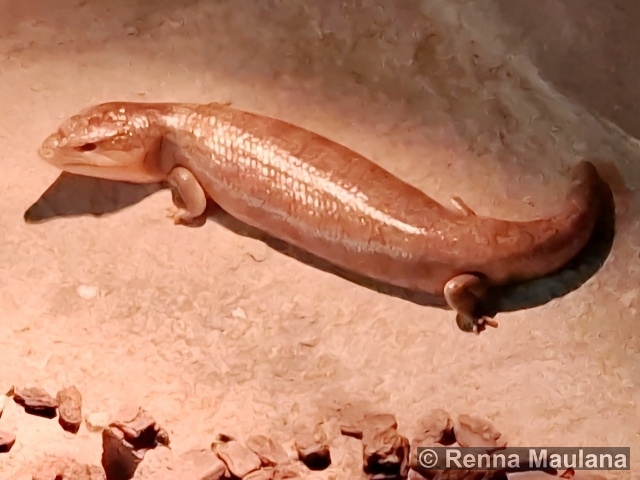
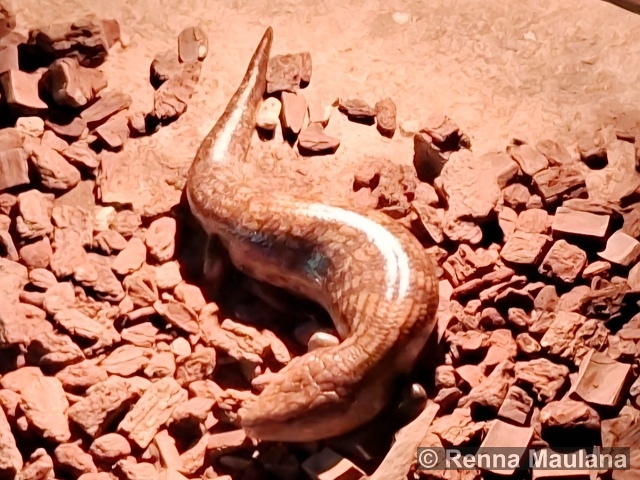
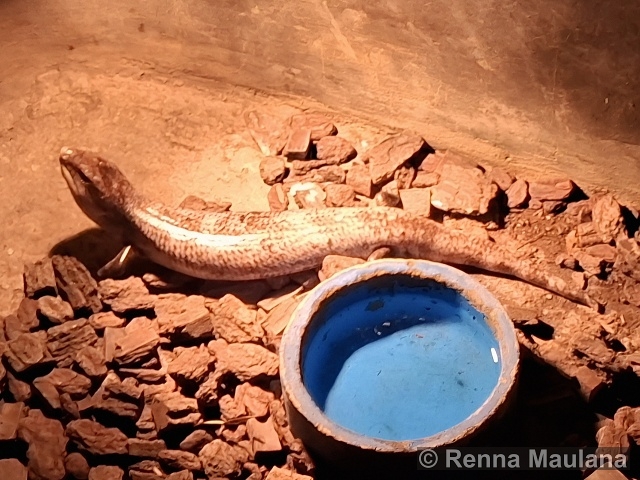
Description: The Indonesian Blue-tongued Skink (Tiliqua gigas) is one of the largest members of the blue-tongued skink group, reaching a total length of approximately 50-60 cm. It has a robust, cylindrical body, relatively short legs, and a thick tail. Its coloration ranges from grayish-brown to olive-brown, often with dark transverse bands across the body and tail. Like other blue-tongued skinks, it is known for its distinctive bright blue tongue, which contrasts sharply with the pink interior of its mouth.
Related Species: The genus Tiliqua contains several closely related species, including:
Ecology: Tiliqua gigas is diurnal and terrestrial reptile that inhabits humid tropical environments. It is commonly found in lowland rainforests, secondary forests, forest edges, and occasionally agricultural areas. This species is an opportunistic omnivore, feeding on insects, earthworms, snails, fruits, flowers, and other plant material. It is ovoviviparous, meaning that females give birth to live young rather than laying eggs externally.
General Distribution: The Indonesian Blue-tongued skink is native to eastern Indonesia and New Guinea. In Indonesia, it occurs in Papua and several islands of the Maluku region, including the Kei Islands, Tanimbar Islands, Ambon, and Halmahera. It is also widely distributed throughout Papua New Guinea.
Additional Information: Tiliqua gigas is generally regarded as a species of Least Concern (LC) due to its broad distribution and relatively stable population. It is popular among reptile enthusiasts because of its calm temperament and distinctive appearance.
Main Threats: Although widespread, local populations may be affected by habitat loss caused by deforestation, agricultural expansion, and land conversion. Illegal collection for the exoctic pet trade also remains a concern in some areas.
Unique Fact: When threatened, Tiliqua gigas performs an impressive defensive display by flattening its body, hissing loudly, and exposing its bright blue tongue. This striking behavior is believed to help deter predators by making the lizard appear larger and potentially dangerous, despite being completely non-venomous.
Author of text and photos: Renna Maulana
Photographed in Rumah Ulin Arya, Samarinda, East Kalimantan, Indonesia, on 10 May 2026.


 Poslat emailem