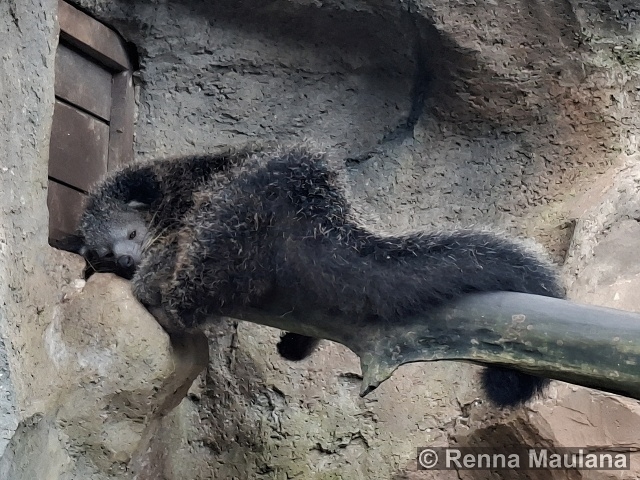
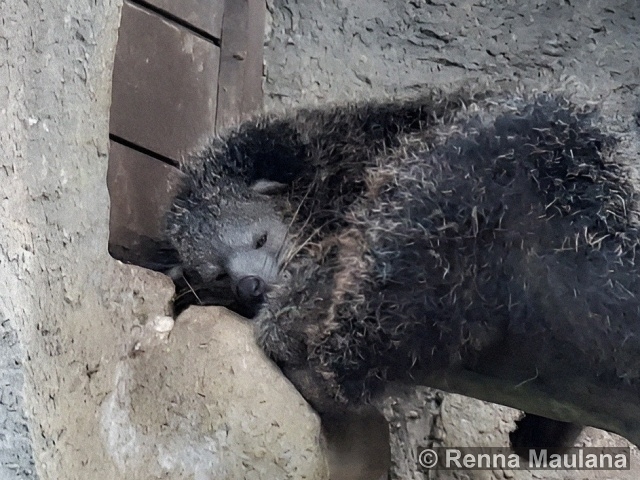
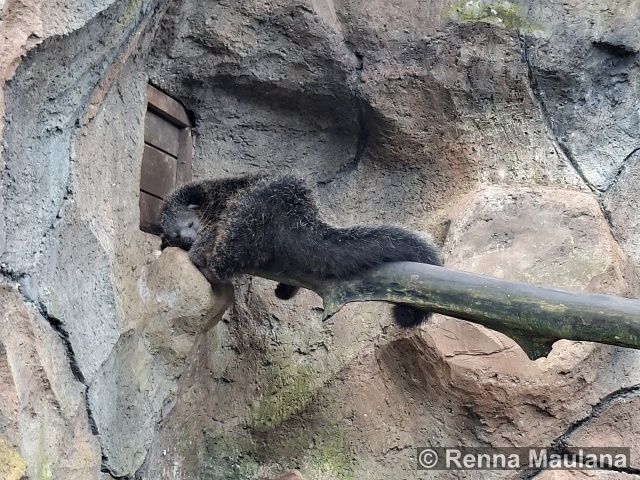
Description: The binturong, also known as the bearcat, is a medium-sized carnivoran belonging to the family Viverridae. Despite its common name, it is neither a bear nor a cat, but a member of the civet and mongoose family. It has long, coarse, black fur with lighter tips around the face and ears, often giving it a slightly grizzled appearance. Its face is adorned with long white whiskers that are highly sensitive and help with navigation in dense forest canopies. One of its most distinctive features is its prehensile tail, which functions like a fifth limb. This strong, muscular tail allows the binturong to grasp branches and maintain balance while moving through trees, making it highly adapted to an arboreal lifestyle. Interestingly, female binturongs are generally larger than males, sometimes by around 20%. Adult individuals typically measure between 60-95 cm in body length and weigh around 9-20 kg.
Related species: Within the family Viverridae, the binturong is closely related to species such as the Asian palm civet (Paradoxurus hermaphroditus), the small Indian civet (Viverricula indica), and the otter civet (Cynogale bennettii). Arctictis binturong is the only extant species within its genus, making it a monotypic lineage.
Ecology: Binturongs are arboreal and primarily inhabit tropical rainforests, from lowland areas to montane forests. Although classified within the order Carnivora, they are opportunistic omnivores, with fruit, especially figs (Ficus spp.), forming the major part of their diet. They may also consume small birds, eggs, insects, and rodents when available.
Ecologically, binturongs play an important role as seed dispersers. Some rainforest plant seeds germinate more effectively after passing through their digestive system, making them important contributions to forest regeneration.
Distribution: The species is distributed across South and Southeast Asia, including Indonesia (Sumatra, Kalimantan, and Java), Malaysia, Thailand, Myanmar, Laos, Cambodia, Vietnam, the Philippines (Palawan), northeastern India, Bhutan, and southern China.
Conservation status: According to the IUCN Red List, the binturong is classified as Vulnerable. In Indonesia, it is also a legally protected species.
Threats: Major threats include deforestation due to agricultural expansion (such as palm oil plantations), logging, and forest fires. Hunting and illegal wildlife trade also pose significant risks, as the species is sometimes captured for bushmeat, traditional medicine, or the exotic pet trade.
Additional information: Binturongs possess scent glands near their tail region, and their scent has often been described as similar to popcorn or buttered popcorn due to the presence of 2-acetyl-1-pyrroline, a compound also found in freshly pooped corn. This scent is used for territorial marking within their habitat.
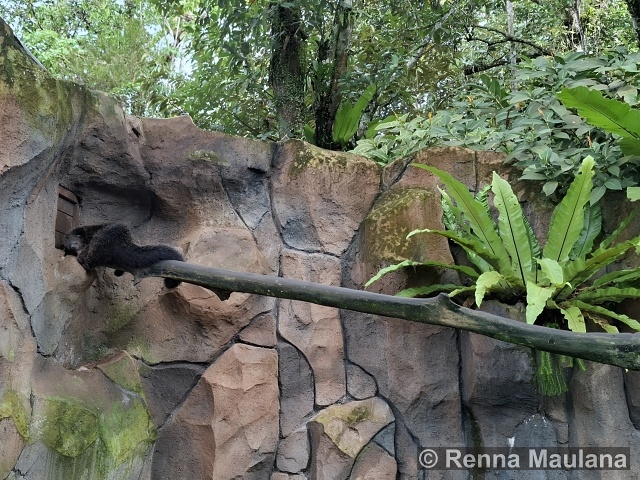
Author of text and photos: Renna Maulana
Photographed in Rumah Ulin Arya, Samarinda, East Kalimantan, Indonesia, on 10 May 2026.


 Poslat emailem