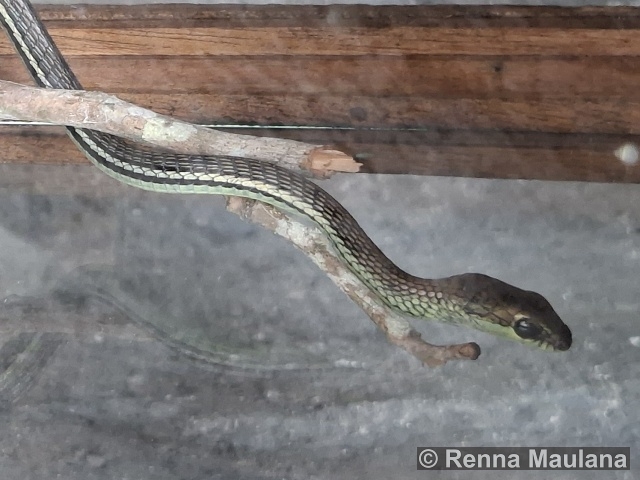
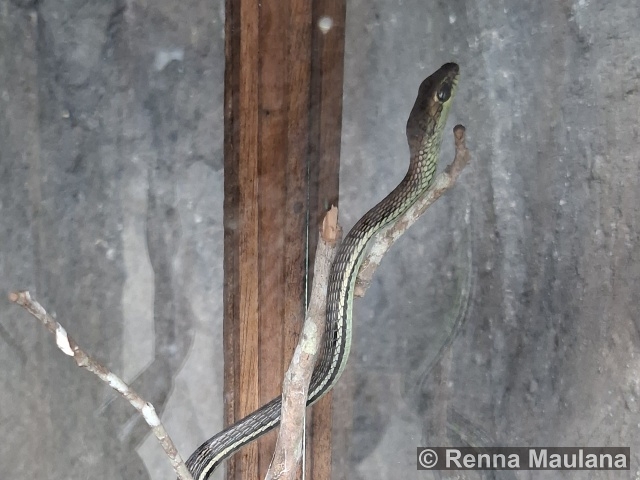
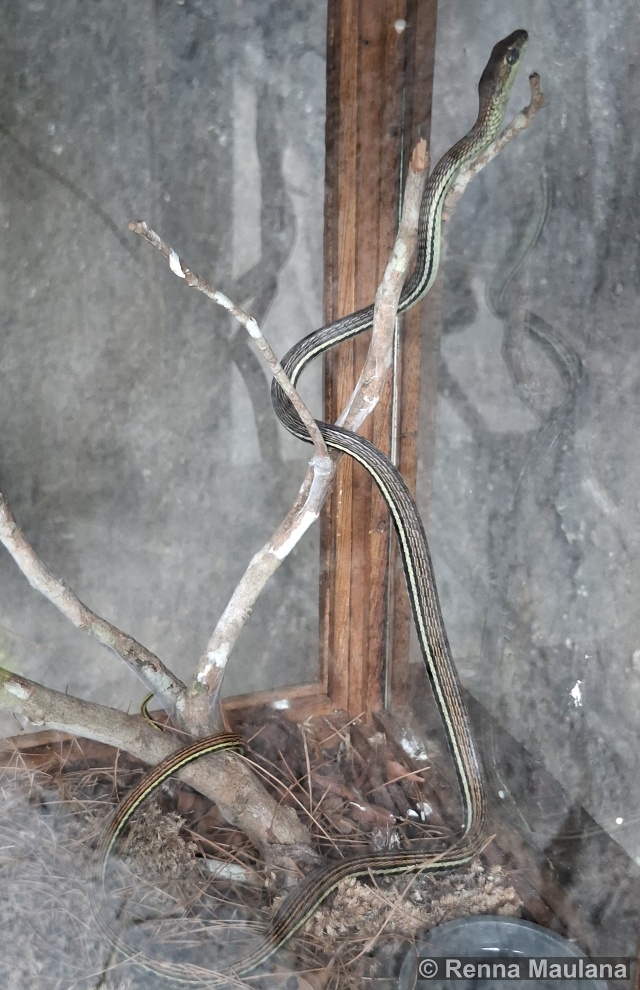
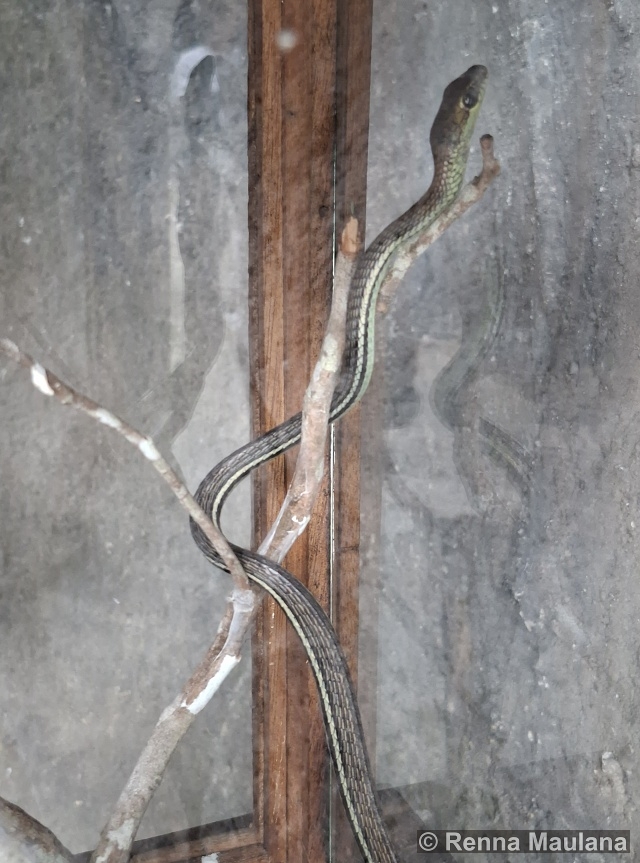
Description: The Striped Bronzeback is a slender arboreal snake with a long tail and an agile body adapted for life among trees and shrubs. Adults usually reach around 100-150 cm in total length. Its body coloration varies from light bronze and brown to grayish olive. The most distinctive feature of this species is the pair of dark longitudinal stripes running along the sides of the body toward the tail. The head is slightly elongated and broader than the neck, with relatively large eyes and round pupils that provide excellent daytime vision. The underside of the body is usually pale yellow or greenish cream.
Ecology: This species is diurnal, meaning it is mainly active during the day. It spends most of its time moving quickly through vegetation and tree branches. The Striped Bronzeback is known for its speed and agility. Although very active, it is generally non-aggressive and usually escapes rapidly when disturbed by humans. Its diet mainly consists of small arboreal animals such as geckos, lizards, tree frogs, and occasionally small birds or bird eggs.
General Distribution: The Striped Bronzeback is widely distributed throughout Southeast Asia, including Indonesia (Sumatra, Java, Kalimantan, Sulawesi, Bangka Belitung, Riau Islands, and Nias), Malaysia, Brunei Darussalam, Singapore, Southern Thailand, the Philippines, especially Palawan, and the Sulu Islands.
Related Species: The genus Dendrelaphis contains many species of bronzeback snakes found across Asia and Australia. Some related species commonly found in Indonesia include Dendrelaphis pictus (Painted Bronzeback), Dendrelaphis formosus (Elegant Bronzeback), and Dendrelaphis kopsteini (Kopstein’s Bronzeback).
Additional Information: According to the IUCN Red List, the Striped Bronzeback is classified as Least Concern. Its population is considered relatively stable due to its strong adaptability to different environments.
Habitat Threats: Although deforestation and habitat conversion affect its natural habitat, this species adapts well to secondary forests, plantations, gardens, and even urban environments as long as vegetation and prey remain available.
Unique Fact: The Striped Bronzeback has excellent vision and can easily detect fast-moving prey during the day. Its dark body stripes may also help camouflage the snake while it moves rapidly through branches and foliage.
Author of text and photos: Renna Maulana
Photographed in Rumah Ulin Arya, Samarinda, East Kalimantan, Indonesia, on 10 May 2026.


 Poslat emailem